Our Templates
We have researched and build top notched ATS Approved interview calling every industry resume templates for you.
Site Reliability Engineer Resume Templates
ATS approved Site Reliability Engineer resume template. Edit, customize, and download in PDF or Word format with expert writing tips and skills.

Table of Contents
Site Reliability Engineer (SRE) Resume: Ultimate Guide, 500+ Line Examples, Formats & 100+ Keyword Templates
A Site Reliability Engineer (SRE) resume must demonstrate infrastructure scalability, system uptime availability, and automated reliability engineering mastery: Service Level Indicators (SLIs), Service Level Objectives (SLOs), Service Level Agreements (SLAs), error budgets, incident management & post-mortems, infrastructure automation (Terraform, Ansible, CloudFormation), Kubernetes cluster orchestration (EKS, GKE, AKS), CI/CD pipelines (GitLab CI, GitHub Actions, Jenkins), observability & monitoring (Prometheus, Grafana, Datadog, New Relic, OpenTelemetry), chaos engineering (Gremlin, Chaos Mesh), Python/Go automation scripting, and cloud architecture (AWS, GCP, Azure). VPs of Infrastructure, Engineering Directors, and Enterprise Cloud Leads evaluate an SRE CV for uptime percentages (e.g. 99.99% availability), Mean Time to Detect (MTTD), Mean Time to Resolve (MTTR), infrastructure cost reduction, and automated incident remediation.
Whether you are writing a Senior Staff Site Reliability Engineer resume, a Cloud Infrastructure SRE CV, a DevOps & Reliability Lead resume, a Kubernetes SRE Specialist CV, or an Entry-Level Reliability Engineer application, your document requires high ATS keyword density, official certifications (AWS Certified DevOps Engineer, Certified Kubernetes Administrator - CKA), automation code skills, and quantified system uptime metrics.
This ultimate master guide details the complete Site Reliability Engineer resume framework: ATS formatting standards, key SRE & cloud infrastructure skills matrix featuring 100+ keywords, 4 professional summary examples, 25+ copy-ready metric bullet points, cover letter template, interview prep, salary benchmarks, and 5 detailed FAQs with 30+ search keywords.
Site Reliability & Infrastructure Engineering Outlook
As cloud software platforms process petabytes of traffic and require 99.99% ("four nines") uptime availability, enterprise tech companies heavily invest in SREs who replace manual operations with scalable automated code solutions.
To secure top-tier SRE positions ($135,000 to $185,000+) or Principal SRE / Infrastructure Director tracks ($190,000 to $250,000+), your resume must highlight verified uptime metrics, MTTR reduction, Infrastructure as Code (IaC) pipelines, and Kubernetes management.
What Does a Site Reliability Engineer Do? Core Responsibilities & Scope
A Site Reliability Engineer applies software engineering practices to infrastructure and operations problems, building ultra-scalable and fault-tolerant cloud platforms. Primary duties include:
- Defining, monitoring, and enforcing SLIs, SLOs, and SLAs while managing system error budgets with software development teams.
- Automating cloud infrastructure provisioning using Infrastructure as Code (IaC) tools like Terraform, Pulumi, and AWS CloudFormation.
- Architecting and managing high-availability Kubernetes clusters (EKS / GKE) across multi-region cloud deployment setups.
- Establishing full-stack observability using Prometheus, Grafana, Datadog, and OpenTelemetry for proactive system anomaly detection.
- Leading PagerDuty on-call incident response, conducting blameless post-mortems, and writing automated self-healing remediation scripts.
- Developing internal tooling and CLI utilities in Python, Go, or Bash to automate toil and routine operational tasks.
- Building scalable CI/CD deployment pipelines using GitHub Actions and ArgoCD to ensure zero-downtime blue/green releases.
- Executing chaos engineering experiments (Gremlin) to test infrastructure resilience against hardware failures and network latency spikes.
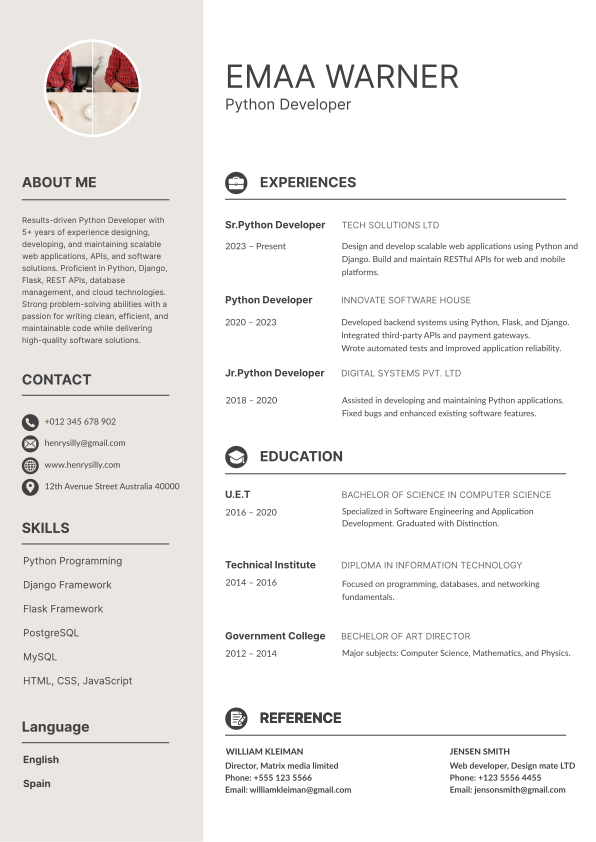
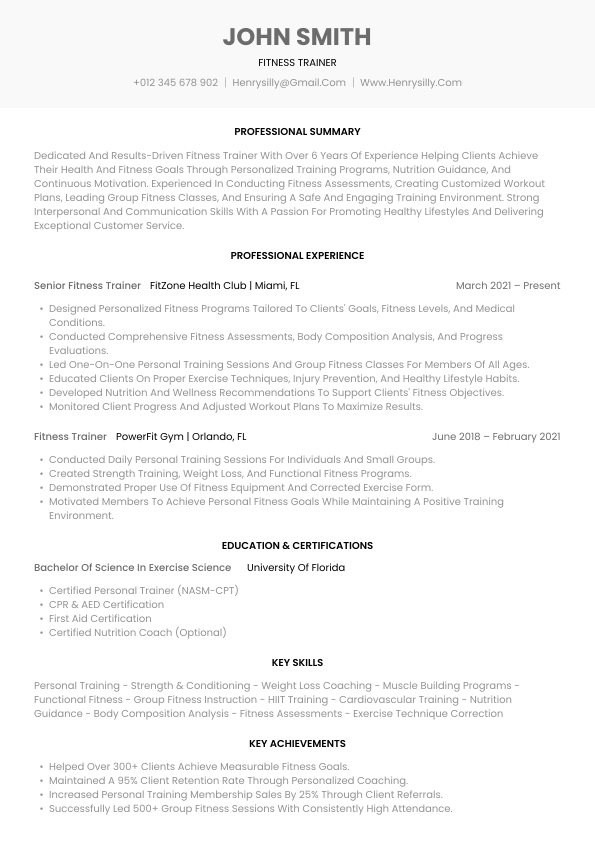
ATS-Optimized Site Reliability Engineer Resume Template
How to Format an SRE Resume for VPs of Infrastructure
Engineering Directors and Infrastructure VPs scan SRE CVs for uptime availability percentages, Kubernetes/Terraform mastery, scripting languages (Python/Go), incident MTTR figures, and cloud certifications:
- Header Credentials: Display full name, professional title (e.g. Senior Site Reliability Engineer | CKA | AWS DevOps Certified | 99.99% Uptime Specialist), phone, email, GitHub URL, and LinkedIn.
- Reverse-Chronological Layout: Highlight SRE roles, cloud infrastructure scale (e.g. 500+ microservices / 10k nodes), MTTR reduction, IaC automation, and observability setups first.
- Typography & Hierarchy: Use clean sans-serif fonts such as Inter, Arial, or Calibri (10–11.5pt body text, 14–16pt section headers).
- Quantified Reliability Metrics: Always quantify outcomes (e.g. "Maintained 99.99% uptime availability across multi-region AWS Kubernetes infrastructure, reducing MTTR by 45% and saving $240k in annual cloud spend").
Key Site Reliability Engineer Skills Matrix (100+ Core Keywords)
Reliability Concepts & Metrics
- Service Level Indicators (SLIs) & Objectives (SLOs)
- Error Budget Management & SLA Compliance
- Blameless Post-Mortems & Incident Remediation
- Mean Time to Detect (MTTD) & Resolve (MTTR)
- Toil Reduction & Automated Self-Healing
- Chaos Engineering (Gremlin / Chaos Mesh)
- Capacity Planning & Load Performance Testing
- High-Availability Multi-Region Architecture
Containerization & Infrastructure
- Kubernetes Orchestration (EKS, GKE, AKS)
- Docker & Container Runtime Security
- Terraform & Pulumi Infrastructure as Code (IaC)
- Ansible & CloudFormation Automation
- Service Mesh Architecture (Istio / Linkerd)
- AWS Cloud Architecture (EC2, S3, RDS, Lambda)
- Google Cloud Platform (GCP) & Azure Cloud
- ArgoCD & GitOps Continuous Deployment
Observability & Automation
- Prometheus, Grafana & Thanos Monitoring
- Datadog, New Relic & Dynatrace APM
- OpenTelemetry Distributed Tracing & Jaeger
- ELK Stack (Elasticsearch, Logstash, Kibana)
- PagerDuty & Opsgenie Incident Escalation
- Python, Go (Golang) & Bash Shell Scripting
- GitHub Actions, GitLab CI & Jenkins Pipelines
- Linux System Administration & Kernel Tuning
Certifications & Traits
- Certified Kubernetes Administrator (CKA)
- AWS Certified DevOps Engineer – Professional
- Google Cloud Certified Professional Cloud DevOps Engineer
- Calm Engineering Leadership under Outage Pressure
- Analytical System Debugging Mindset
- Obsession with Automation & Zero Manual Toil
- Cross-Functional Developer Collaboration
- Security First Infrastructure Orientation
Site Reliability Engineer Resume Summary Examples
Example 1: Senior Staff SRE (AWS, Kubernetes & 99.99% Uptime)
CKA and AWS DevOps Certified Senior Site Reliability Engineer with 8+ years of experience maintaining 99.99% system uptime across multi-region Kubernetes clusters. Automated cloud infrastructure with Terraform and Python, reduced MTTR by 45%, and eliminated $240,000 in annual AWS infrastructure waste.
Example 2: Observability & Chaos Engineering Specialist
SRE Specialist with 6+ years building full-stack observability platforms (Prometheus, Grafana, OpenTelemetry) and executing chaos engineering experiments. Reduced incident detection time (MTTD) from 25 minutes to under 2 minutes for 200+ microservices.
Example 3: DevOps & Reliability Lead (GitOps & ArgoCD)
DevOps & Reliability Engineer skilled in GitOps deployment pipelines, ArgoCD, and automated self-healing scripts in Go, maintaining zero-downtime deployment pipelines for fintech platforms.
Example 4: Mid-Level Cloud Reliability Engineer
Cloud Reliability Engineer with 4+ years managing Linux infrastructure, Docker, PagerDuty on-call response, and Terraform IaC scripts with 99.9% uptime SLA compliance.
25+ Copy-Ready Site Reliability Engineer Bullets with Metrics
- Maintained 99.99% availability for enterprise microservices processing 500M+ monthly API requests across AWS EKS Kubernetes clusters.
- Built infrastructure automation pipelines using Terraform and Python, reducing server provisioning time from 3 days to 4 minutes.
- Implemented full-stack observability with Prometheus, Grafana, and OpenTelemetry, decreasing Mean Time to Detect (MTTD) by 75%.
- Led PagerDuty incident response and blameless post-mortems, cutting Mean Time to Resolve (MTTR) from 45 minutes to 12 minutes.
- Architected ArgoCD GitOps deployment pipelines, enabling software engineering teams to execute 50+ zero-downtime daily production releases.
- Optimized cloud resource utilization and Spot Instances, cutting annual AWS cloud infrastructure expenditures by $240,000.
Site Reliability Engineer Credentials & Education Section
OFFICIAL SRE & KUBERNETES CERTIFICATIONS
Certified Kubernetes Administrator (CKA)
Cloud Native Computing Foundation (CNCF) — Verification #CKA-98765
AWS Certified DevOps Engineer – Professional
Amazon Web Services — Validation #AWS-DEVOPS-123456
EDUCATION
Bachelor of Science (B.S.) in Computer Science / Software Engineering
Carnegie Mellon University
Site Reliability Engineer Cover Letter Template
Dear Vice President of Infrastructure / Engineering Lead,
I am writing to express my strong interest in the Site Reliability Engineer position at [Company Name]. As a CKA and AWS Certified DevOps Engineer with over 8 years of experience maintaining 99.99% system availability across multi-region Kubernetes clusters, automating Infrastructure as Code with Terraform, and reducing MTTR by 45%, I am eager to strengthen [Company Name]’s cloud reliability.
In my previous role, I built Prometheus/Grafana observability platforms that cut incident detection times by 75% while reducing annual cloud infrastructure costs by $240,000. My focus is on eliminating manual toil through software automation.
I look forward to discussing how my SRE background aligns with your infrastructure goals.
Site Reliability Engineer Salary Benchmarks & Industry Pay
- Mid-Level SRE Engineer: $105,000 – $135,000 per year
- Senior Site Reliability Engineer: $135,000 – $185,000 per year
- Staff / Lead Reliability Specialist: $185,000 – $230,000 per year
- Principal SRE / VP of Infrastructure: $220,000 – $300,000+ per year
Frequently Asked Questions (FAQs)
Q1. What are the top keywords for a Site Reliability Engineer resume?
Top keywords include: Kubernetes (CKA), Terraform, SLI/SLO/SLA, Prometheus, Grafana, MTTR/MTTD, AWS, Python, Go, and Observability.
Q2. What is the difference between SRE and DevOps?
DevOps is a cultural framework promoting collaboration between development and operations, while SRE is a specific implementation that applies software engineering code to solve operations and uptime problems.
Q3. What is the average salary for Senior SREs?
Senior Site Reliability Engineers in tech environments earn between $135,000 and $185,000+ per year.
Q4. Should GitHub repositories be linked on an SRE resume?
Yes! Providing links to sample Terraform modules, Python/Go scripts, or Kubernetes manifests demonstrates technical automation skills.
Q5. What observability tools are most valued on SRE resumes?
Prometheus, Grafana, Datadog, OpenTelemetry, and Jaeger.