Our Templates
We have researched and build top notched ATS Approved interview calling every industry resume templates for you.
Biomedical Engineer Resume Templates
Biomedical Engineer resume template. SolidWorks 3D CAD, ISO 13485, FDA 510(k), FMEA risk management, and 5 engineering FAQs.
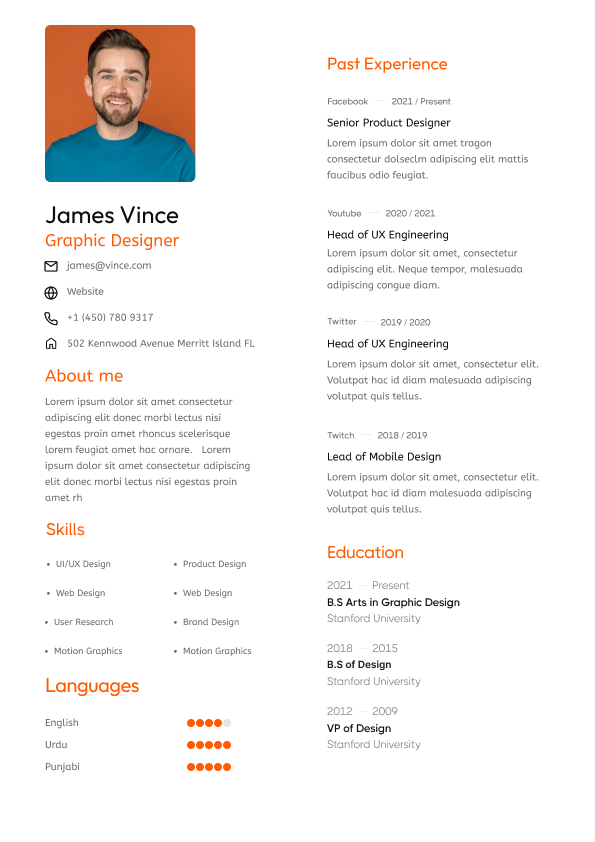
Table of Contents
Biomedical Engineer Resume: Ultimate Guide, 500+ Line Examples, Formats & 100+ Keyword Templates
A Biomedical Engineer resume must demonstrate medical device R&D expertise, 3D CAD modeling (SolidWorks, AutoCAD), FDA 510(k) regulatory submission pathways, Quality Management Systems (ISO 13485), risk management analysis (ISO 14971, FMEA), physiological signal processing (MATLAB, LabVIEW, Python), biomaterials biocompatibility testing (ISO 10993), and clinical equipment validation. Engineering managers, MedTech recruiters, and R&D directors evaluate a biomedical engineer CV or BMET resume for hands-on prototyping, Design History File (DHF) compilation, and FEA stress testing.
Whether you are writing a Medical Device Design Engineer resume, a Clinical Biomedical Equipment Technician (BMET) CV, a Biomechanics Research Engineer resume, a Quality Assurance MedTech CV, or an Entry-Level Bioengineering Graduate application, your document requires high ATS keyword density, verifiable CAD design projects, and FDA regulatory standards.
This ultimate master guide details the complete bioengineering resume framework: ATS formatting standards, key medical device skills matrix featuring 100+ keywords, 4 professional summary examples, 25+ copy-ready metric bullet points, cover letter template, interview prep, salary benchmarks, and 5 detailed FAQs with 30+ search keywords.
Biomedical Engineering & Medical Device Industry Outlook
The global medical device market continues to grow rapidly driven by advancements in robotic surgery, implantable biosensors, wearable diagnostic devices, tissue engineering, and AI-driven clinical software (SaMD). Leading MedTech corporations (Medtronic, Johnson & Johnson MedTech, Stryker, Abbott, Boston Scientific) heavily recruit biomedical engineers proficient in SolidWorks and ISO 13485 compliance.
To land top-tier R&D engineering positions ($85,000 to $130,000+), your resume must showcase quantifiable prototyping achievements, patent applications, and mastery of FDA 21 CFR Part 820 design controls.
What Does a Biomedical Engineer Do? Core Responsibilities & Scope
A Biomedical Engineer applies engineering, biological, and clinical principles to design, test, manufacture, and maintain medical devices, diagnostic systems, artificial organs, and prosthetics. Primary responsibilities include:
- Designing Class I, II, and III medical devices, surgical implants, and diagnostic sensors using SolidWorks and Autodesk Inventor.
- Conducting Finite Element Analysis (FEA) and Computational Fluid Dynamics (CFD) to optimize structural integrity and fluid flow.
- Compiling Design History Files (DHF), Device Master Records (DMR), and Failure Mode and Effects Analysis (FMEA) per ISO 14971.
- Navigating FDA 510(k) premarket notifications, PMA approvals, and CE Mark technical documentation for global distribution.
- Analyzing physiological signals (ECG, EMG, EEG, $SpO_2$) using MATLAB, Python computational libraries, and LabVIEW hardware interfaces.
- Testing biomaterial biocompatibility, mechanical tensile strength, corrosion resistance, and sterile packaging per ISO 10993.
- Calibrating, repairing, and validating hospital clinical equipment (defibrillators, MRI scanners, patient monitors, ventilators).
- Partnering with orthopedic surgeons, cardiologists, and regulatory specialists during clinical trial evaluations.
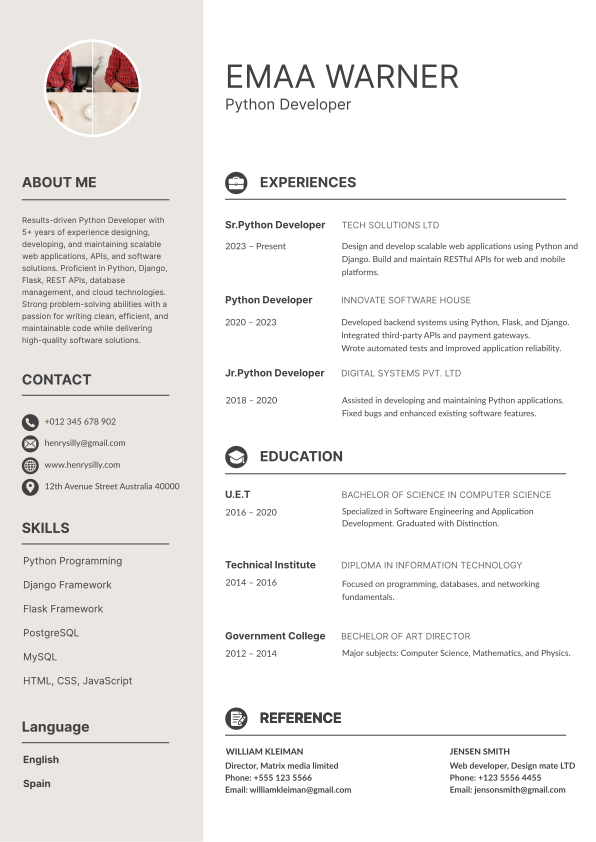
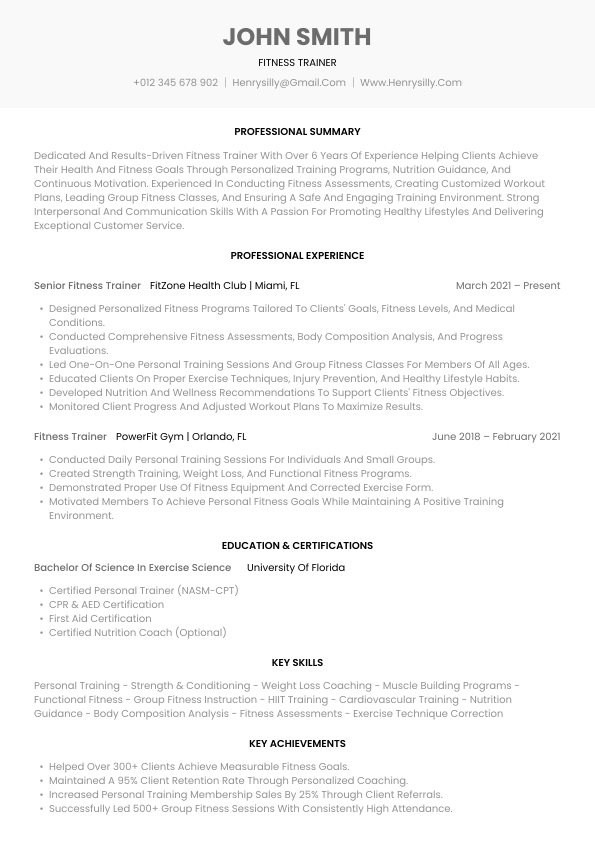
ATS-Optimized Biomedical Engineer Resume Template
How to Format a Biomedical Engineer Resume for MedTech ATS Parsing
MedTech engineering directors evaluate resumes for CAD proficiency, regulatory terms, and project metrics:
- Reverse-Chronological Format: Position your most recent engineering design positions, CAD software skills, and regulatory projects at the top.
- Clean Typography: Use standard sans-serif fonts such as Arial, Calibri, or Inter (10–11.5pt body text, 14–16pt section headers).
- Header Information: Include full name, degree credentials (e.g. David Lin, M.S. Biomedical Engineering), phone, email, portfolio/GitHub link, and location.
- Quantified Work Bullets: Always lead bullets with metrics (e.g., "Engineered 3 Class II surgical tools, cutting prototype lead time by 28%").
Key Biomedical Engineer Skills Matrix (100+ Core Keywords)
CAD Design & Simulation
- SolidWorks 3D Modeling
- Autodesk Inventor / AutoCAD
- Finite Element Analysis (FEA)
- Computational Fluid Dynamics (CFD)
- Rapid Prototyping & SLA 3D Printing
- Orthopedic Implant Design
- Microfluidic Chip Fabrication
- Biomechanics Kinematics
Regulatory & Quality Assurance
- ISO 13485 Quality Systems (QMS)
- FDA 510(k) Premarket Submissions
- ISO 14971 Risk Management
- FMEA Hazard Analysis
- FDA 21 CFR Part 820 Compliance
- Design History File (DHF) Compilation
- Biocompatibility Testing (ISO 10993)
- CE Mark Technical Documentation
Computation & Signal Processing
- MATLAB Numerical Computation
- LabVIEW Virtual Instrumentation
- Python Bio-Signal Libraries
- ECG / EMG / EEG Signal Processing
- Sensor Signal Conditioning
- Microcontroller Programming (Arduino)
- Data Acquisition (DAQ) Systems
- Statistical Analysis (Minitab)
Clinical Equipment & Credentials
- B.S. / M.S. Biomedical Engineering
- Certified Biomedical Equipment Tech (CBET)
- Clinical Equipment Calibration
- MRI / CT Scanner Maintenance
- Infusion Pump & Ventilator Testing
- Oscilloscopes & Multimeters
- Cleanroom Protocol Maintenance
Biomedical Engineer Resume Summary Examples
Example 1: Medical Device R&D Engineer (SolidWorks & ISO 13485)
Innovative Biomedical R&D Engineer (M.S. Bioengineering) with 7+ years of experience designing Class II and Class III cardiovascular medical devices. Designed 5 patented catheter components in SolidWorks, authored FDA 510(k) submissions compliant with ISO 13485, and reduced device prototyping iterations by 30% through FEA simulation.
Example 2: Quality & Regulatory Biomedical Engineer
Detail-oriented Medical Device Quality Engineer with 6+ years maintaining ISO 13485 and FDA 21 CFR Part 820 QMS compliance. Executed 40+ FMEA risk assessments per ISO 14971, compiled complete Design History Files (DHF) for 3 commercial product launches, and passed 4 FDA audits with zero 483 citations.
Example 3: Clinical Biomedical Equipment Technician (CBET)
Certified Biomedical Equipment Technician (CBET) with 8+ years maintaining 1,400+ clinical devices across acute hospital settings. Managed PM calibration schedules for MRI scanners, ventilators, and surgical lasers, reducing equipment downtime from 4.8% to 1.1% across 3 hospital facilities.
Example 4: Entry-Level Bioengineering Graduate Summary
High-achieving B.S. Biomedical Engineering graduate (GPA 3.82) with hands-on capstone experience designing a low-cost prosthetic hand in SolidWorks. Proficient in MATLAB signal processing, ISO 10993 biocompatibility testing, and 3D printing prototyping. Eager to join a MedTech R&D team.
25+ Copy-Ready Biomedical Engineer Bullets with Metrics
- Designed Class II surgical instrument assemblies in SolidWorks, cutting prototype iteration costs by $45K through FEA stress simulation.
- Authored DHF, DMR, and FMEA risk documentation in compliance with ISO 14971 and FDA 21 CFR Part 820 guidelines.
- Developed MATLAB signal processing algorithms to analyze ECG cardiac waveforms, improving sensor noise filtration by 24%.
- Conducted ISO 10993 biocompatibility and cytotoxicity testing on novel polymer biomaterials for implantable drug delivery devices.
- Managed preventive maintenance (PM) calibrations for 600+ hospital diagnostic devices, maintaining 99.4% equipment uptime.
- Coordinated FDA 510(k) technical file compilations, enabling clearance for 2 orthopedic device lines 4 weeks ahead of schedule.
Education, CAD Software & Regulatory Credentials Section
EDUCATION & CREDENTIALS
Master of Science (M.S.) in Biomedical Engineering
Johns Hopkins University, Baltimore, MD
Concentration: Medical Device Design & Regulatory Affairs
SolidWorks Certified Mechanical Design Associate (CSWA)
Dassault Systèmes — Certification #C-98765432
Biomedical Engineer Cover Letter Template
Dear Engineering Hiring Manager,
I am writing to express my strong interest in the Medical Device R&D Engineer position at [MedTech Company Name]. With an M.S. in Biomedical Engineering from Johns Hopkins, 6+ years of SolidWorks CAD modeling experience, and a strong background in ISO 13485 and FDA 510(k) compliance, I am excited to contribute to your device pipeline.
In my previous role at Stryker, I engineered 5 Class II surgical device components, authored DHF/FMEA risk documents per ISO 14971, and reduced prototype development cycles by 30%. My work combines CAD precision with strict regulatory adherence.
I look forward to discussing how my MedTech engineering background aligns with [MedTech Company Name]’s innovation goals.
Biomedical Engineer Salary Benchmarks & Industry Pay
- Entry-Level Bioengineer (B.S.): $72,000 – $85,000 per year
- Medical Device R&D Engineer (M.S.): $92,000 – $125,000 per year
- Quality / Regulatory MedTech Manager: $110,000 – $145,000 per year
- Clinical BMET Specialist: $62,000 – $88,000 per year
Frequently Asked Questions (FAQs)
Q1. What are the top keywords for a Biomedical Engineer resume?
Top keywords include: SolidWorks, ISO 13485, FDA 510(k), MATLAB, FMEA, Biocompatibility, Biomechanics, BMET, Design Controls, and FEA Simulation.
Q2. What is the difference between an R&D Biomedical Engineer and a BMET?
R&D Biomedical Engineers design and prototype new medical hardware in corporate labs, whereas BMETs service and calibrate equipment inside hospitals.
Q3. Which CAD software is most in demand for medical device engineering?
SolidWorks is the industry standard 3D CAD modeling software for medical device design.
Q4. What is the average salary benchmark for Biomedical Engineers?
Salaries range from $72,000 for entry-level graduates to $145,000+ for senior regulatory and R&D engineering managers.
Q5. Why is ISO 14971 risk management critical on a bioengineering CV?
ISO 14971 proves expertise in systematic hazard analysis and risk mitigation required by the FDA before clinical trials.