Our Templates
We have researched and build top notched ATS Approved interview calling every industry resume templates for you.
Firmware Engineer Resume Templates
ATS approved firmware engineer resume template, no charges. Edit, customize, download PDF/DOCX. AI vocabulary enhancement included. Professional templates.
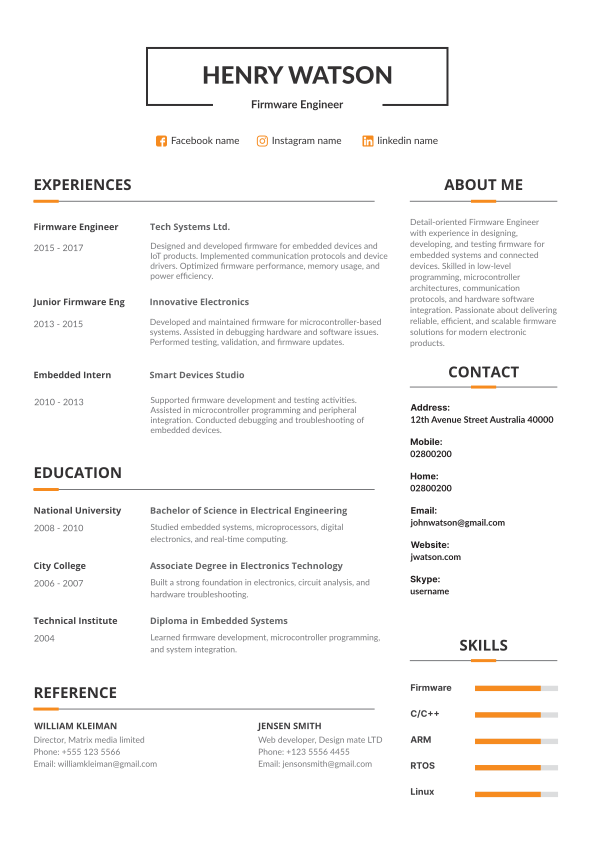
Table of Contents
Firmware Engineer Resume: Examples, Writing Guide & Key Skills
Firmware engineering is unique in the software industry: your code directly interfaces with hardware registers, microcontrollers, and real-time execution constraints. When hiring managers screen firmware resumes, they don't look for vague coding descriptions—they look for specific MCU architectures, communication protocols, RTOS experience, and hardware metrics.
This comprehensive guide provides a copy-ready firmware engineer resume sample, breakdowns of what recruiters scan for, hardware performance metrics, and level-by-level advice to help you craft a standout resume that passes ATS filters and impresses hiring teams.
What Hiring Managers Scan For in Firmware Engineers
Unlike web or desktop software roles, firmware engineering resumes are evaluated on platform-specific depth and low-level debugging capability:
- Microcontroller & Processor Families — ARM Cortex-M (STM32, NXP, Microchip), ESP32, AVR, PIC, or RISC-V
- Real-Time Operating Systems (RTOS) — FreeRTOS, Zephyr, ThreadX, or bare-metal state machines
- Low-Level Protocols — I2C, SPI, UART, CAN/CAN-FD, USB, BLE, Ethernet
- Lab & Debugging Equipment — Oscilloscopes, logic analyzers, JTAG/SWD debuggers, J-Link
- Resource Constraints — Flash/RAM memory footprint optimization, power management, microsecond interrupt latencies
Complete Sample Firmware Engineer Resume
Use this battle-tested resume layout as a foundation. Click the template below to build and customize your resume in our builder.
Henry Watson
Firmware Engineer | Embedded C/C++ | FreeRTOS | ARM Cortex-M | CAN & SPI
12th Avenue Street Australia 4000 • [email protected] • 02800200 • jwatson.com
Summary Detail-oriented Firmware Engineer with 5+ years of experience in designing, developing, and testing firmware for embedded systems and connected devices. Skilled in low-level C/C++ programming, ARM microcontroller architectures, RTOS thread management, and hardware-software integration. Proven track record of optimizing power consumption and reducing latency for high-reliability electronics.
Languages: Embedded C, C++, Python (testing scripts), Assembly
Platforms & MCU: ARM Cortex-M0/M4/M7 (STM32, NXP), ESP32, AVR
RTOS & OS: FreeRTOS, Zephyr, Bare-Metal Driver Architecture
Protocols: I2C, SPI, UART, CAN, BLE, USB, MODBUS
Tools & Lab: JTAG/SWD, Oscilloscopes, Logic Analyzers, Keil MDK, STM32CubeIDE, Git
Experience
Firmware Engineer — Tech Systems Ltd., Australia | 2015–2017
- Designed and developed bare-metal and FreeRTOS firmware for STM32F4-based industrial IoT products, reducing sensor latency by 35%
- Implemented custom SPI and CAN bus drivers with DMA, decreasing CPU utilization by 22% and improving data throughput
- Optimized power management routines and sleep modes, extending battery life from 14 days to 24 days on remote monitoring nodes
- Collaborated with PCB design team during hardware bring-up; debugged noise issues using logic analyzers and digital oscilloscopes
Junior Firmware Engineer — Innovative Electronics | 2013–2015
- Developed driver modules for UART, I2C, and flash memory peripherals on AVR and ARM microcontrollers
- Wrote automated python test scripts to validate firmware builds against hardware test benches
- Assisted in performing field firmware updates (Bootloader) and resolving customer-reported bug tickets
Education Bachelor of Science in Electrical Engineering — National University (2008–2010)
Certifications Diploma in Embedded Systems • Certified RTOS Application Developer
Format & ATS Rules for Firmware Resumes
Follow these formatting rules to ensure your resume passes Applicant Tracking Systems (ATS) and presents clearly to hiring engineers:
- Format: Reverse-chronological format for experienced engineers; single-column clean layout
- Length: 1 page for professionals under 8 years of experience; 2 pages max for senior engineers
- File Type: Submit as PDF unless specifically requested as .docx
- Keywords: Explicitly mention exact protocols (e.g., "CAN", "I2C", "SPI") rather than generic terms like "communication protocols"
Hardware Metrics & Performance Bullets
Quantifiable metrics separate strong firmware engineers from average applicants. Incorporate hardware metrics such as:
| Metric Type | Example Bullet Point |
|---|---|
| Interrupt Latency | "Reduced ISR latency from 50 µs to 12 µs by refactoring interrupt handlers and using DMA" |
| Power Consumption | "Decreased sleep-mode current draw from 15 mA to 2.5 mA, increasing battery life by 40%" |
| Memory Footprint | "Optimized code size, shrinking RAM utilization by 30 KB to fit within MCU internal memory" |
| Deployment Scale | "Shipped firmware running reliably on 50,000+ deployed smart metering devices worldwide" |
Firmware Engineer Skills & Stack Breakdown
Group your technical skills logically into distinct categories on your resume:
- Core Languages: C, C++, Assembly (ARM, AVR), Python
- RTOS & Architectures: FreeRTOS, Zephyr, Keil RTX, Bare-metal, ARM Cortex-M0+/M3/M4/M7, ESP32
- Bus & Wireless Protocols: I2C, SPI, UART, CAN, LIN, BLE, Wi-Fi, USB, Ethernet
- Hardware & Debug Tools: JTAG, SWD, Oscilloscopes, Logic Analyzers, Multimeters, Soldering, PCB Schematics
- Software Engineering & Build: Git, CMake, Makefiles, CI/CD, MISRA C, Unit Testing (Unity/CMock)
Level-by-Level: Junior, Mid-Level & Senior Firmware Engineers
Junior / Entry-Level Firmware Engineer
Focus heavily on academic capstone projects, lab coursework, robotics competitions, and personal microcontroller builds. Emphasize familiarity with C, basic protocols (I2C/SPI), and debugging tools.
Mid-Level Firmware Engineer (3–6 Years)
Highlight full-lifecycle firmware development, board bring-up experience, driver creation, RTOS multitasking, and shipped production hardware metrics.
Senior / Principal Firmware Lead (7+ Years)
Emphasize firmware architecture, safety compliance (ISO 26262, IEC 62304, MISRA C), hardware/silicon vendor selection, mentoring junior engineers, and cross-functional leadership with electrical and mechanical teams.
Common Mistakes to Avoid
- Being Too Generic: Writing "worked with microcontrollers" instead of specifying "developed drivers for STM32F4 Cortex-M4 MCU".
- Ignoring Hardware Context: Omitting the lab tools (logic analyzers, oscilloscopes) used to debug firmware issues.
- Listing High-Level Software Skills Only: Failing to showcase C/C++ memory management, pointer manipulation, and bitwise operations.
- Overlooking Quantifiable Impact: Not specifying battery life extension, latency reduction, or unit production volume.
Frequently Asked Questions
Q1. What is the difference between an Embedded Engineer and a Firmware Engineer?
While the terms are often used interchangeably, firmware engineers typically focus specifically on low-level code that directly controls microcontrollers and hardware peripherals (bare-metal, RTOS), while embedded engineers may also work on embedded Linux systems, device drivers, and higher-level application layers.
Q2. Should I include personal microcontroller projects on my resume?
Yes! Personal projects using STM32, ESP32, or custom PCB designs are highly valued by hiring managers, especially for entry-level and mid-level roles.
Q3. What is the most important skill for a firmware engineer resume?
Proficiency in C/C++ combined with hands-on experience in hardware debugging using scopes, logic analyzers, and JTAG/SWD interfaces.
Final Words
A standout firmware engineer resume clearly communicates your technical precision, low-level coding expertise, and ability to bridge hardware and software. Tailor your resume to each job posting by using exact protocol names, MCU families, and measurable performance results.